
What Is an ETF, and Why Does Northland Use Them?

Arthur Salzer, CFA, CIM | Founder & CEO, Northland Wealth Management
I have spent almost four decades managing portfolios for Canadian families. Over that time I have watched fund managers make well-reasoned, carefully researched calls about individual companies, and still underperform the index year after year. Not because they were wrong about the businesses. Because markets had already priced in most of what they knew, and the fees consumed whatever edge remained.
That observation is the foundation of how Northland uses exchange-traded funds in the public equity portion of client portfolios. The argument is not primarily about cost, though ETFs are substantially cheaper than actively managed alternatives in the same markets. The argument is about access. Access to the companies that markets have already identified as the most valuable in their respective economies, held automatically, in proportion to their proven worth, without requiring anyone to predict which businesses will matter most.
Let me explain what that mechanism actually involves.
What is an ETF?
An ETF, or Exchange-Traded Fund, is a single investment that holds many securities. When you buy one unit, you own a small piece of every company the ETF contains.
Most broad-market ETFs track a published index such as the S&P 500 or the S&P/TSX Composite. Each index holds companies in proportion to their market capitalization, the total value that markets assign to each business at any given moment. Larger companies hold larger positions. As companies grow, their weight grows with them. The mechanism adjusts continuously. Here is what the top 10 look like inside the S&P 500 today.

Three practical reasons ETFs make sense
Before getting into how the index mechanism works, three practical benefits are worth stating plainly.
• One transaction replaces dozens. Building a diversified portfolio of 20 to 50 individual stocks requires 20 to 50 separate purchases. Each trade carries a commission and a bid-ask spread. Add ongoing rebalancing, dividend reinvestment, and tracking corporate actions across all those positions, and the transaction costs and administrative burden compound quickly. One ETF purchase replaces all of it.
• Tax efficiency versus mutual funds. In a taxable account — a personal account, a holding company, or a family trust — mutual fund investors face a structural disadvantage. Canadian mutual fund trusts accumulate unrealized capital gains over time. When existing investors redeem, those gains are distributed to all remaining unitholders, including investors who arrived recently. New investors can inherit a tax bill from gains that built up before they invested. ETFs avoid this through the creation and redemption mechanism: institutional investors exchange ETF units for the underlying securities in kind, with no capital gain triggered at the fund level. For families with significant holdings in taxable structures, this difference is material.
• Proportional ownership of the market's most proven companies. A single ETF purchase delivers automatic exposure to hundreds of businesses, weighted by the market's collective assessment of their value. Understanding exactly how that weighting works — and why it is more powerful than it first appears — is the rest of this article.
Two layers of work before you own a single company
I want to be precise about something, because this is commonly misunderstood.
ETFs are routinely called passive investments. The ETF itself is passive, mirroring the index mechanically. But the index it mirrors is actively governed. S&P Dow Jones Indices characterizes its own committee as an active committee in its published writing. That is not a critic's label. It is their own.
The U.S. Index Committee has 10 voting members, all full-time S&P Dow Jones Indices staff, who decide by simple majority. Their identities are kept deliberately anonymous to prevent lobbying. They meet monthly. Their deliberations are confidential. The official methodology states clearly: constituent selection is at the discretion of the Index Committee.
Two stages govern every company's path into the index. The first is a quantitative screen: four consecutive quarters of positive GAAP earnings from continuing operations, a minimum market cap of $22.7 billion, adequate trading liquidity, U.S. domicile, and sufficient public float. Meeting all of these earns a company a place on the eligibility list, not a seat in the index. The second stage is the committee's judgment.
That judgment cuts both ways. The committee can exclude a company that satisfies every quantitative criterion. It can keep a company in the index even when that company appears to breach removal criteria, if the committee judges that ongoing conditions do not yet warrant a change. And the committee has the authority to revise the eligibility rules themselves.
Tesla demonstrates both dimensions clearly. The company first satisfied the earnings screen in mid-2020, after four consecutive profitable quarters under GAAP. The committee passed on it at the September 2020 quarterly rebalancing despite Tesla meeting all stated criteria, without public explanation. Tesla's stock fell 21% the day that non-inclusion was announced. Three months later, the committee added Tesla in December 2020 at approximately $460 billion in market cap, making it the largest company ever added to the index at the point of inclusion. The September skip was a judgment call. So was the December addition.
The reverse case is instructive too. During the 2021 meme-stock rally, GameStop crossed the market capitalization threshold for index inclusion. The committee kept it out, applying qualitative judgment that the share price reflected speculation rather than business fundamentals. That also was a judgment call, and one that plausibly protected investors in index-tracking funds.
For contrast: the Russell 1000 reconstitutes annually in June through a fully public, rules-based process with no committee discretion. The methodology is published in advance, applied mechanically, and produces no surprises. The S&P 500 is a different kind of instrument: a curated portfolio governed by a small, anonymous, decision-making body with real and confidential authority. Understanding that is not a criticism. It is a precise description of what the index actually is.
What the ETF removes, in this context, is a different layer entirely: the additional fund manager deciding, on top of everything above, which eligible stocks to overweight or underweight in pursuit of returns above what the index delivers. The committee governs eligibility and balance. Market capitalization sizes the positions by demonstrated value. The ETF mirrors both mechanically, at low cost, without a further layer of discretionary judgment, which is the layer the evidence suggests rarely pays for itself net of fees.
Consider what this meant for NVIDIA. In 2015 it was a mid-sized graphics company. The AI hardware cycle that would eventually make it one of the most valuable businesses in history was not visible in the data. But anyone holding a broad S&P 500 ETF through that decade owned NVIDIA at every stage of its ascent, in proportion to what markets had proven it was worth at each moment. Not because of a macro call. Because the index held it, and kept holding more as it grew.
Research by Arizona State University professor Hendrik Bessembinder found that roughly 4% of listed stocks account for all net wealth creation in the U.S. equity market over the long run. The other 96% collectively underperform Treasury bills. Active managers tend to trim positions that have appreciated significantly. In practice, this means systematically selling the stocks producing the index's return. The index, by being too disciplined to sell its winners, captures the 4% that matter.
The strongest case for indexing in large public equity markets is not that fees are lower, though they are meaningfully lower. It is that the index captures the companies that matter by refusing to sell them.
The Canadian picture is different, and it matters
The S&P/TSX Composite reflects an economy I understand at a fairly personal level. I grew up in Hamilton, Ontario. My father was a metallurgical engineer at Dofasco for thirty years. The industrial, resource-oriented character of Canada's economy is not an abstraction to me. The TSX top ten reflect that character clearly: five financial institutions, two energy companies, a railway, and two technology businesses.
Royal Bank has compounded value for its shareholders through every cycle I have lived through as a practitioner. Enbridge moves more than 30% of North American crude oil. Canadian Pacific Kansas City now connects three countries by rail. Shopify built one of the most consequential e-commerce platforms in the world from a small office in Ottawa. These are Canada's most proven franchises, held in proportion to their market-demonstrated value.
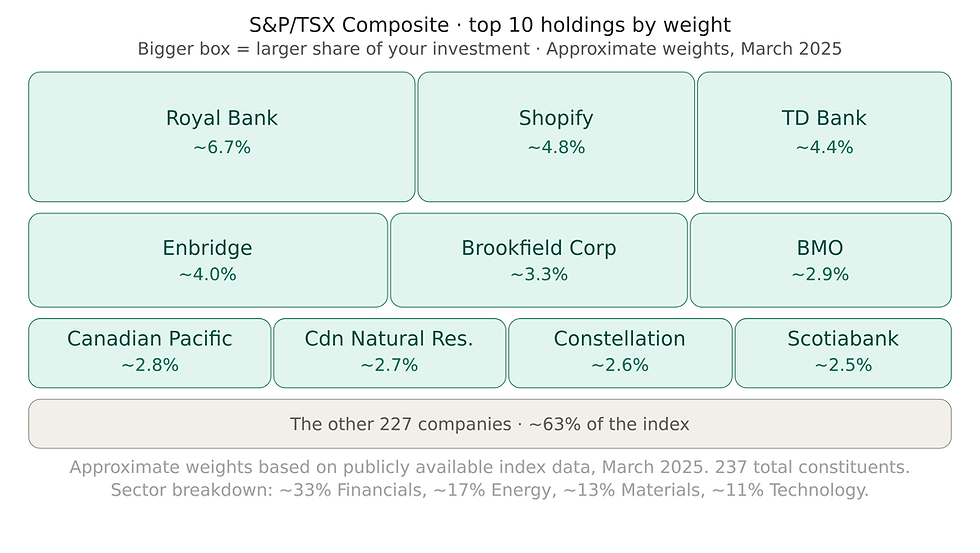
I was working in the institutional trust business when Nortel peaked at 36% of the S&P/TSX Composite in 2000. That experience has not left me. Watching a single company represent more than a third of the Canadian equity market, then watching it collapse, was formative. The index now caps individual names at 10%. The single-stock risk is addressed. The sector concentration at 33% financials and 17% energy remains. Knowing that is not a reason to avoid the TSX. It is a reason to understand what you own when you buy it.
Place the two diagrams alongside each other. The S&P 500's top ten are predominantly technology and platform businesses connected to the global digital economy. The TSX's top ten are predominantly financial and energy businesses connected to the Canadian economy. These are genuinely different exposures. Held together, they represent two different kinds of proven economic leadership, accessed through the same disciplined mechanism. Held separately, each one overstates the diversification it actually provides.
For many of our clients, there is a further consideration. Canadian UHNW families often already carry concentrated exposure to Canada's financial and energy sectors through their homes, their private business income, their bank accounts, and their direct shareholdings. For those families, a TSX ETF reinforces what they already have. The U.S. equity allocation addresses what they typically lack.
Where the index mechanism stops
Public equity markets, even the best-structured index products, cannot give an investment portfolio everything it needs.
Over the past several years, Northland has helped client families access businesses like SpaceX privately, before they reached public markets. That kind of investment requires relationships, due diligence, and access that takes many years to build. No index product provides it, because no index covers private markets. That is precisely where the information advantages and access constraints that make active management genuinely worth its cost are found.
Private equity, private credit, real assets, and alternative strategies operate where information is not public and where the quality of who you know and what you can evaluate genuinely differentiates outcomes. The index handles the parts of the portfolio where the evidence clearly favours it. We concentrate our active effort on the parts where it does not.

What ETFs cannot do
An ETF follows its market. When the S&P 500 falls, your S&P 500 ETF falls. When the largest names correct, cap-weighting means you feel it in proportion. A TSX ETF during a period of banking stress will reflect and sometimes amplify that stress for families who already carry Canada's financial sector in multiple forms.
An ETF does not know your structure. It does not know that you already own the banks in your dividend portfolio, or that your business income is tied to the same economic cycle as the index. It does not coordinate with your estate plan, your holdco, or your insurance strategy.
That coordination is our work. The ETF is the foundation. What we build on top of it, specific to how each family is actually situated, what they already own, and what they genuinely need, is where the planning begins.
Frequently Asked Questions
About the Author
Arthur Salzer, CFA, CIM is the Founder and CEO of Northland Wealth Management, an independent multi-family office serving ultra-high-net-worth Canadian families. He has managed portfolios for UHNW Canadian families since the early 1990s, across institutional trust, private wealth, and independent multi-family office settings.


